Menu

EN

CES 2026 confirmed a feeling many already shared: immersive technologies are entering a new phase of maturity. In the aisles of the lounge, the smart glasses were omnipresent, in increasingly varied and successful forms. Camera, microphone, speakers, screen, artificial intelligence embedded or connected to the cloud, and sometimes even capabilities of Augmented reality (AR) advances: these devices are no longer a futuristic demonstration, but rather concrete tools, ready to be integrated into professional uses. On the Chinese market, Sales Quarterly glasses even have increased by 57%compared to last year.
In the fall of 2026, we are therefore offering you a short overview of the main innovations and opportunities in the industry., as well as an overview of our recent work at 3D advice, at the crossroads of Smart glasses And AI-powered applications.
The smart glasses, are a portable device that can be worn like a regular pair of glasses, but that integrates several key technological components:
Concretely, these glasses allow you to consult and manipulate information without leaving your real environment, with your hands free. They open the way to uses that have hitherto been complex, even impossible, with a PC or smartphone.
Here is a selection of models that are currently marking the market, or that are about to do so in the year:
Meta Ray-Ban
Indicative price: around 450€
Strengths: design very similar to conventional glasses, photo/video capture, AI voice assistant, discreet daily use.
XREAL One S
Indicative price: around 500€
Strengths: high quality AR display, stable spatial anchoring, very good compromise between compactness and immersion.
Meta Ray-Ban Display
Indicative price: around 800€
Strengths: addition of an integrated display, visual notifications, the first building blocks of lightweight AR.
Rayneo X3 Pro
Indicative price: 1200 Euros
Strengths: SLAM and 6DoF capabilities, better FormFactor thanks to a “One Lens” solution
Rokid Smart Glasses
Indicative price: around €300
Strengths: advanced integration of AI (ChatGPT, Qwen, DeepSeek...), ultra-light, compatible with corrective lenses, strong “intelligent assistant” orientation.
Lumus ZOE
Indicative price: not communicated
Strengths: extended field of view, advanced AR optics, positioning clearly oriented to professional uses.
For remote maintenance, the most common use to date in the industry, we should also note the presentation of the Vuzix LX1 monocular models and the RealWear ARC3.
Very recently, Conseil 3D designed for a customer an application prototype for XREAL Air 2 Ultra, intended for researchers working in an environment where the use of a PC or smartphone is complicated (gloved, dirty or busy hands, field constraints, specific conditions).
This application combines:
We purposely went well beyond basic commands such as:
“Enter the value 12.5 for this sample”
to propose interactions that are closer to human reasoning, for example:
“Calculate the average of the measurements taken between 3 p.m. and 4 p.m. and enter it in the appropriate box.”
“Do you see an outlier in my January 16 reports? ”
The result: completely hands-free note taking and data analysis, contextualized, and immediately usable in the field.
At the same time, we developed the prototype of a rendering improvement application, this time on smartphones.
It allows:
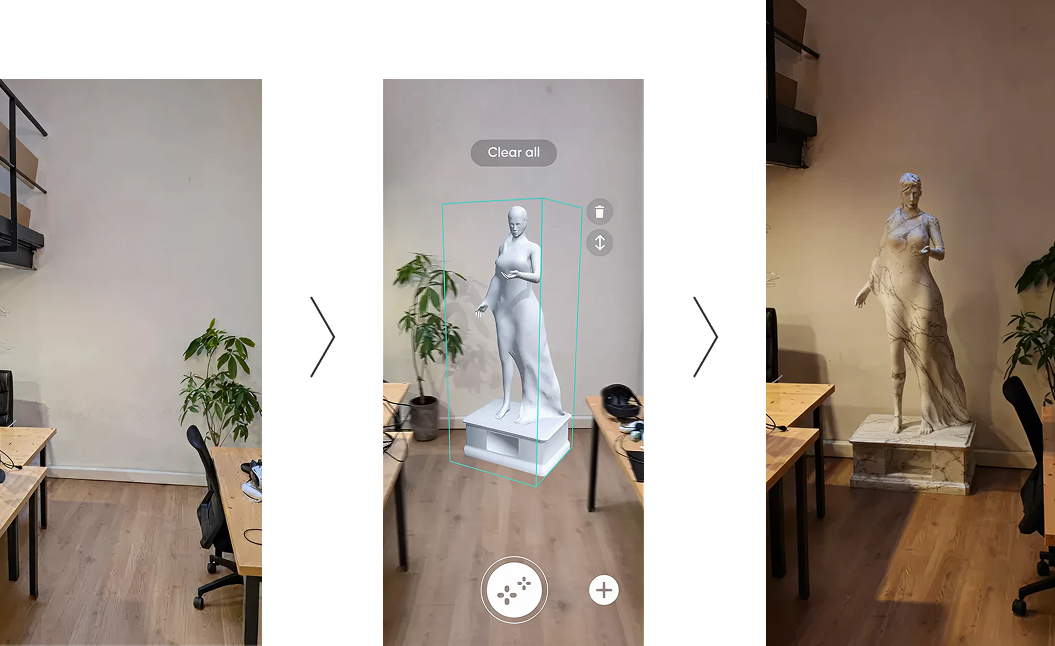
Even if this application is slightly outside the scope of smart glasses, it perfectly illustrates a fundamental trend: the convergence between XR and generative AI, which is transforming the way we design, visualize, and communicate around digital content.
We can't say more yet... but we'll talk to you about it very soon!
The smart glasses open up an extremely vast field of applications, in particular for the sectors that we already support.
In all of these cases, the application can explain, guide, analyze, alert, while leaving the user fully immersed in their real environment.
At Conseil 3D, our know-how historical in XR (virtual, augmented and mixed reality) is a key asset for this type of project:
We don't just adapt an existing app to glasses: we design applications designed from the start for these new supports.
Smart glasses and AI are no longer gadgets: they are now concrete levers for performance, training and communication for businesses.
Do you have an idea, a need, or simply the desire to explore these new possibilities?
Let's talk about it. At Conseil 3D, we support our customers from design to implementation, with tailor-made XR applications, designed for your business uses.
Contact us and let's build your next immersive experiences together.